

By Maria Teresa Santoro
Print edition: Empíreo, 2016
Digital edition: Tesseractum, 2024
Summary
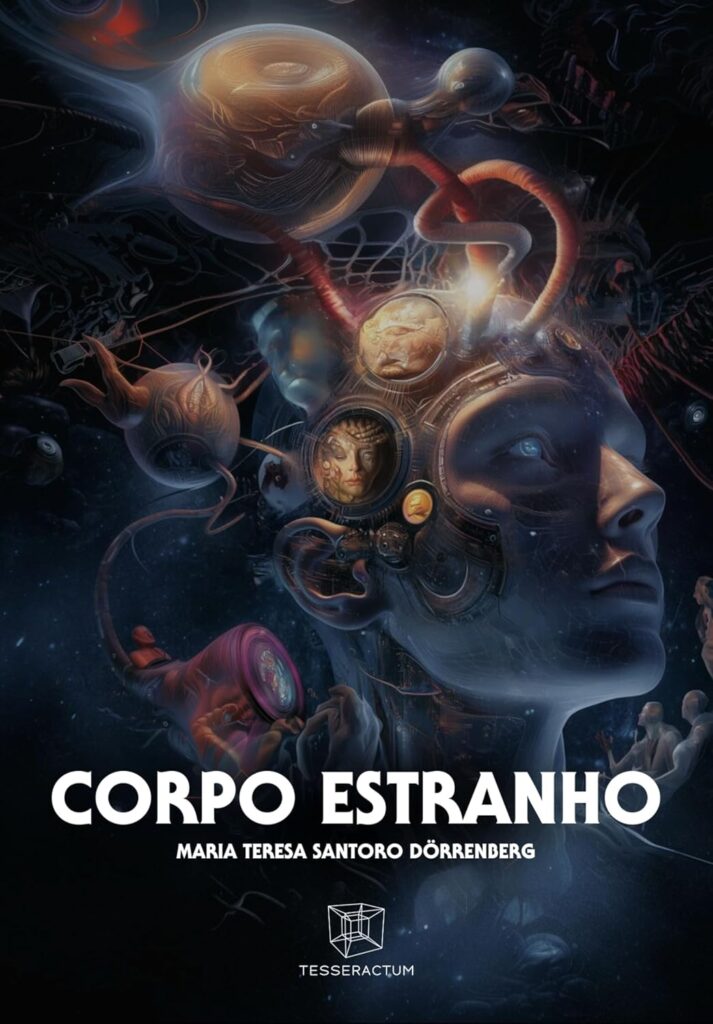
This is the story of a cyborg, known as Mear. Built in 1999 to perform at an art show in Berlin, he meets a body artist going by the name of O., who persuades him to break free of the endless repetitive cycles of his exhibition programming and set out on new adventures. Anything is possible, because Mear is not just a standard cyborg. He was built with the ability to transform himself into anybody he wants, teleporting himself to any place and time of his choice, able to understand and express himself through any form of communication. These extraordinary skills are intended to help the cyborg become independent and to grow and develop in the human world, leading to a generation of more capable beings.
Mear is tall, strong and is attractive by human standards, although his silicone skin is slightly bluish. He has an implanted human brain, but he doesn’t know or doesn’t remember to whom it belonged.
Mear’s dramatic adventures begin when he discovers that the intentions of his creators have changed. They are negotiating his sale to a Japanese company as a prototype for a new generation of cyborgs. As the negotiations with the Japanese advance, Mear and O. plan a trip for him to learn about the history of the body in the arts and media. He sets out on the voyage of discovery or, more accurately, runs away.
Just as this story of a cyborg is unusual, so too is the action in the first chapter, which relates the story of a party hosted by a Mr Star, where there is an upheaval in time. His unusual guests, simulations of those entities that Mear has met in his travels, come together to meet the real Mear for the first time or to renew his acquaintance. However, the guest of honour does not turn up and the party starts to get out of control as the guests discuss possible reasons for his no-show, each of them advancing arguments anchored in their own contexts, times and beliefs. Faced with the developing chaos, the host decides to take resolute action and heads to the controlling computer to press some buttons.
But it is Mear’s adventures into the world of the body as it is represented in art and media that move the plot along, as he learns and changes through his experiences with the characters he meets. He begins his trip in Austria, more precisely at the Vienna Museum of Natural History. There he meets the tiny, chubby statue of Venus of Willendorf, who complains about her unhappy life at the museum, telling him about the powerful magic she wove in the tribe to which she belongs. The two then travel back in time to the Willendorf of more than 25,000 years ago, where the cyborg experiences life in Paleolithic times.
After further adventures with Venus, Mear heads for modern Berlin and decides to see what it is like to be female, transforming himself into a woman. Mear-woman is fascinated with her lightness and the way her body sways and moves. “She” is in the year 2003 to visit the bust of Queen Nefertiti, as this is the year when a British Egyptologist announced to the world that she had found her mummy. This discovery could revolutionise our knowledge of the history of the famous 18th dynasty Egyptian queen. Imprisoned within her limestone bust, the spirit of Nefertiti tells Mear that she doesn’t know how she met her end, if she had been mummified or not and where she had been entombed. She asks Mear to seek out her mummy, so that she can reincarnate and live for eternity. Mear travels back to the year 1300 BC and tells the queen what he discovers. “She” visits Amarna, the city built by the queen and her king and then enters their tomb in search of the mummy.
Having had enough of mummies and their burial chambers, Mear travels to Olympia, the city of the ancient Olympic Games. He makes friends with the god Hermes and studies his statue, which portrays him with the little Dionysus on his lap, an example of Grecian beauty by the artist Praxiteles. Hermes asks Mear to help him find the wine for the closing party of the Games. Dressed as a bacchante, Mear joins in the drunken merrymaking with Dionysus, who plies him with wine. Mear ends up joining the gods in their feasting, but when he gets up to leave, Hermes plays a trick on him, stopping him from leaving on his next adventure. How will the cyborg get out of this?
But Mear manages to escape. He travels through time and space to Cologne at the time of the Middle Ages, 1400 AD. Changing his appearance to a Benedictine monk, he visits the Abbey of Sta. Cecilia where he finds the painting “Madonna with Violets” by the German painter Stefan Lochner. Speaking to Abbess Elisabeth von Reichenstein, patron of the painting, he learns about the religious crisis at the Abbey: the Church and the Emperor want to transform the secular Abbey into a religious convent. Mear participates in the conflict and together with the priests and the abbess he is arrested for disrespecting the Emperor and the Pope. This crisis does not end the way the cyborg expects and he heads for Italy.
In Renaissance Milan Mear meets the artist Leonardo da Vinci, already famous and working for the Duke Sforza. Through the artist’s servant, the cyborg learns about his daily life and habits. Leonardo explains to him about his paintings and inventions while Mear introduces him to the computer and the internet. With the assistance of Luca, a super-computer, Leonardo mends Mear.
Changed, and now in Delft, in Holland, Mear encounters the scene from the painting “The Milkmaid” by Johannes Vermeer being acted out in real life: it is Tanneke preparing the morning porridge. He becomes curious to know if Vermeer used a camera obscura when painting his luminous paintings. He introduces himself as a specialist in the camera obscura and soon finds himself part of a project which is being kept secret as the use of lenses or cameras would undermine the livelihood of artists of the period.
An unexpected aspect of the story is that the cyborg turns out to have feelings and falls in love with the body artist O. In some ways they are similar and Mear feels attracted to her. They speak on Skype, exchange e-mails and there is a moment of passion between them during an escape by Mear to O.’s apartment in Paris. He is concerned about O.’s human condition and is determined to stop her ageing, decline and death. How can he manage this? Who can he ask for help?
Back to the story!
After a secretive period spent with Vermeer, Mear arrives in 1832 at the Quinta do Sordo, close to Madrid, where he meets 77-year-old Francisco de Goya, who is ailing and deaf. Goya is finishing the strange “Black Paintings” and tells Mear that he painted them as a criticism of conservative Spanish society, of war and of the atrocities he has witnessed. The artist is tormented by dreams and terrifying visions and he portrays them. He relates the story of the fresco “Saturn Devouring His Son”, which impresses Mear, who also has strange dreams and visions during his nights at the Quinta.
Still dazed by Goya’s frescoes, the cyborg travels to Montmartre, in the Paris of 1876. The party atmosphere of the “Dance at the Moulin de la Galette” brings together the proletariat and the artists on a summer Sunday, where Mear encounters Auguste Renoir and his friends. Dressed as a girl, the cyborg moves closer to them and hears of the negative criticisms in the newspapers of the last impressionist exhibition. In the middle of the afternoon, Renoir’s friend Lamy encourages him to paint the dance. After some hesitation, Renoir agrees to paint the scene, including his friends as the main figures. He describes how an impressionist composition is created and the girl-Mear ends up getting much closer than expected to the development of the artist’s work.
After modelling for Renoir, Mear arrives at Dessau on a cold night in 1926. In the guise of a young student he examines the daring Bauhaus buildings. He sits in on a class given by the Swiss artist Paul Klee and is captivated by a canvas: Senecio, a geometric head. It resembles the cyborg. Gazing at this, Mear sees the figure whispering and turning its eyes. Equipping Senecio with rods for legs and brushes for arms, the two leap up and down and roll in the grass, the cyborg happily enjoying the play. But then they are interrupted by a threat and Mear becomes entangled in a series of complications in order to recover Senecio and return it to Klee.
After the adventure with Senecio, Mear is in Paris in 1943. It is autumn and drizzling. In Picasso’s apartment he hears a woman crying, but finds the artist in a bar surrounded by friends, the centre of attention. Mear witnesses a jealous argument involving Dora Maar, the photographer and Picasso’s partner, over the attention the painter gives to another woman. When he encounters the cubist painting “Woman with Artichoke”, from 1941, he is disturbed. Was Picasso happy when he painted it, or under the shadow of war? Mear seeks to understand more about the artist and turns to Dora. She shows him the photographic documentation of “Guernica” and introduces him to Picasso.
Still thinking of the brilliant Picasso, Mear sets off on another adventure, this time in New York in 1972, in the guise of a young hippie. A ghostly photograph of the silhouette of the artist Joseph Cornell, taken by the photographer Miguel Duna, captures his interest. At Cornell’s door, Mear persuades the photographer to let him participate in the project. When Cornell opens the door, Mear, Duna and two assistants realise the house has been burgled. In the artist’s room, Duna photographs him. They help Cornell restore his delicate box constructions, which had been damaged. Then comes the discovery: the box “Vermeer’s Secret” has been stolen. The police investigate and interrogate them as the main suspects.
Escaping from the misunderstanding, Mear arrives in 2000 in Wellington, New Zealand, to meet the digital character Gollum from “The Lord of the Rings”. Masquerading as an assistant producer, he enters the film set and observes scenes performed by Andy Serkis, who provides Gollum’s voice and movement. In the projection room, Mear plays the latest scenes and transports himself into the film. He speaks with Gollum about his fragile, digitised body, consumed by the power of the ring. Upon leaving the film, Mear feels altered, as if he exists on the threshold between fiction and reality.
Returning to his identity, Mear watches a presentation by the multimedia artist Star in Paris in 2011. He asks for Star’s help to transform O. into a cyborg, so they can share an extended existence. Star embraces the project. Mear declares his love and proposes the transformation. O. asks for time to consider it while Mear and Star begin developing a prototype in Melbourne, Australia. As they work, Mear wonders whether O. will return. Will the project succeed? What will result from it? Will Mear’s dream come true?